
On November 18, AWS published support for private certificate authorities on connections from Amazon Bedrock AgentCore Identity to private identity providers. An organization can store a root or intermediate authority’s public certificate in AWS Secrets Manager or Amazon S3 and reference it when configuring an eligible credential provider or authorizer. AWS says the service can use it to validate the servers that publish identity discovery information and signing keys or issue OAuth tokens. The feature requires a private endpoint and VPC Lattice, in a region that supports AgentCore private identity providers. It removes a certificate constraint for organizations that already keep the identity service in their own network. AWS feature announcement
That change is easily mistaken for a wider change in authorization. A private route determines whether the managed service can reach the identity provider. A TLS trust configuration establishes the identity of the server it reaches. The token and the receiving application’s policy decide what the caller can do. A team can simplify the second step while retaining its decisions about the other two. This division matters most when a connection fails or when certificate ownership changes. The system needs to show which step stopped, which component was using the old trust material and whether the affected workload recovered.
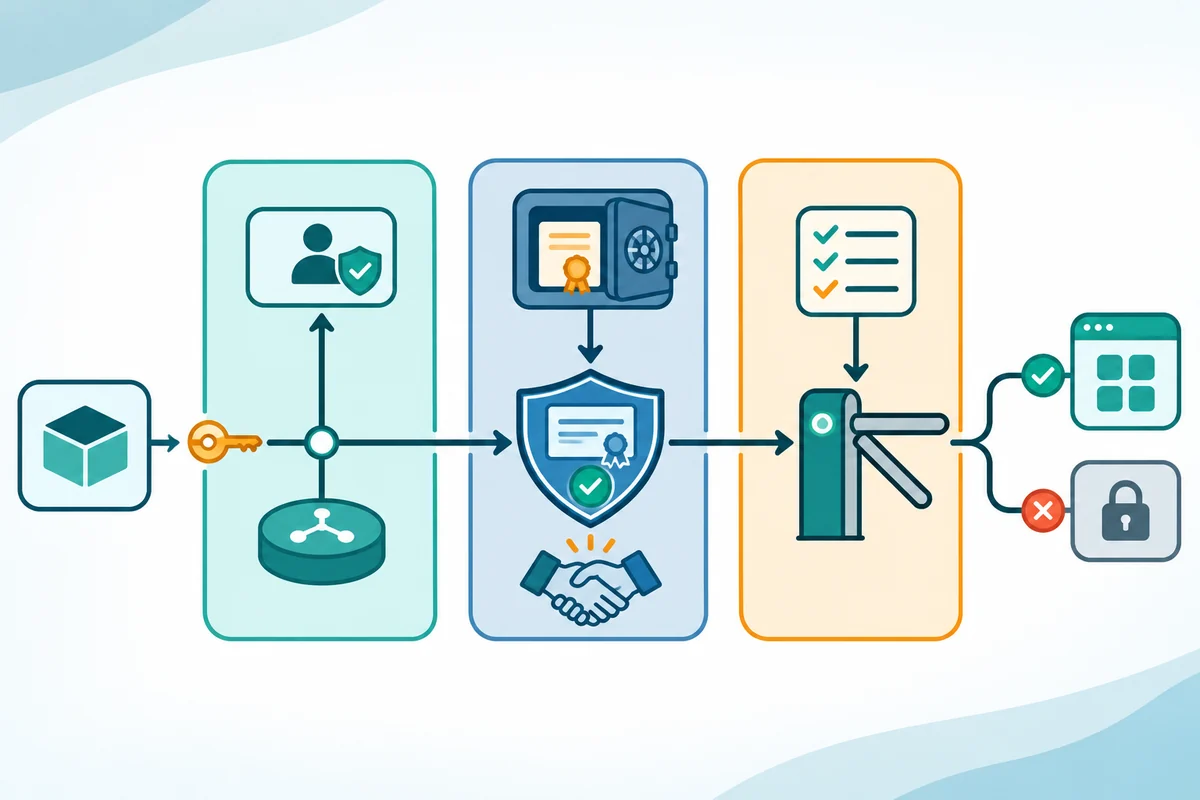
The feature fills a gap in an existing private path#
Consider an internal wiki whose permission system uses a self-hosted identity provider. An AgentCore workload may ask its configured credential provider for an access token. The credential provider reaches the identity provider, authenticates the server connection and requests a token under the configured grant. A wiki request using that token still needs to follow the wiki’s access rules. The feature concerns how the managed AWS component authenticates the identity server. Teams that already issue private TLS certificates can preserve that arrangement at the destination. Availability for one private service does not establish that every component in the agent’s network can use the same trust settings. AWS private identity provider architecture
AWS describes both managed networking and a configuration using customer-managed VPC Lattice resources. The identity provider still needs reachable HTTPS endpoints. The relevant administrative prerequisites can include the right network resources, route and service-linked role. Those are separate from the certificate. A team may succeed in reaching a load balancer and get a TLS validation error. It can also configure the intended CA correctly while having no route from the specified private network. Looking at connection stages helps explain why swapping a certificate would be futile in one case and appropriate in the other. Each workload should have an owner who knows which configuration it uses. AWS networking prerequisites for private identity providers
The AWS engineering article describes an outbound OAuth credential provider and an inbound JWT authorizer as separate uses. In outbound use, AgentCore obtains a token from an identity provider on behalf of a workflow, according to its configured authentication. In inbound use, components such as AgentCore Runtime or Gateway can look up discovery information and signing keys to verify a token presented to them. The trusted TLS certificate helps protect the connection used to obtain those keys. The authority that signed the TLS certificate and the key that signed a JWT perform different jobs. Operators need to test the inbound and outbound paths they actually use. AWS on outbound and inbound support
Documentation can lag a release at this level of detail. AWS previously described putting a certificate from a public trust chain on a load balancer as a workaround for private identity service certificates. Some general networking material still describes that setup. The dated announcement and the dedicated configuration reference now specify what a private trust source looks like. A team can use the former for the network shape and the latter for the feature, then record the account, region and provider type it confirms. That also makes it easier to discover a mismatch between the approved architecture and the actual environment. AgentCore certificate configuration reference
The release notes list common OAuth contexts including machine-to-machine and cases in which an application acts on a user’s behalf. The certificate configuration can be useful in either case because they both connect to the identity provider. Their permissions and consequences are different. A background job’s credential may operate while nobody is logged in. A caller acting for an employee should remain subject to the permissions of that employee and of the destination service. A change to network trust should preserve what the existing workload could do. A test that verifies only that a token comes back is therefore narrower than a test that checks the approved use of the token.
A migration can start by recording what the identity provider already does. For each workload, identify the service that requests the token, its expected issuer and audience, the action it is meant to perform, and how the request is traced. The person approving a change can compare those facts before and after it. This is useful even when the only planned edit is the trust anchor. A coincident client or policy change can alter the permissions at the same time. If both are changed in one release, a later operator needs enough information to find which one actually determined the result.
The service trusts a public certificate for a specific connection#
AWS specifies a PEM file at most 16 KB containing valid root or intermediate CA certificates. This is the public part of the authority material. Private signing keys belong in the authority’s own protected environment. The configured trust anchor is also distinct from the leaf certificate that the identity server presents. The managed service checks that the presented certificate chains to an allowed authority and identifies the intended hostname. Renewing a leaf under the same valid authority can preserve that chain while changing the individual server certificate. If the authority changes, the credential provider’s trusted material has to change as well. AWS certificate requirements · IETF rules for TLS service identity
Identity discovery adds a practical reason to check names separately. The discovery address can identify services used later by the same client. The endpoint where signing keys are served or where a token is issued may use the same hostname or a different one. An initial request can succeed while a later one fails because the certificate or connectivity is different. That distinction is a reason to test the actual permitted flow in staging. A check of the load balancer’s home page gives limited evidence for the lifecycle of a token. Knowing which name is expected at each point also helps decide which team owns the remedy when the service changes.
AWS documents one certificate source for a credential provider. A bundle can contain more than one authority. The storage resource must be in the same region as the provider. Secrets Manager is described as same account. S3 can use a different account in the documented case, with the required owner account information and permissions. A large organization can use that option to let one team maintain the authoritative material while several workload teams reference it. It should still be possible to see which certificate each provider loaded and whether those workloads follow the same rotation time. Shared maintenance reduces duplication and introduces an explicit dependency. AWS constraints for certificate sources
The reason to protect the certificate file is responsibility for what the service trusts. Its bytes are public. Changing them changes which server certificates can pass validation after the provider reloads. A team can restrict writes to the identity operators, give designated configuration principals the appropriate read access and retain an audit trail of changes. It should also know whether an object has a recoverable earlier version. We can ask a concrete review question about any update. Who decided to trust this authority, which workloads got the change and how can an operator check the material currently in force? This is a more useful control than treating a certificate file and an account secret as though they had identical risks.
There are separate permissions around supplying the certificate and loading it. AWS says that on credential provider create or update it reads the certificate with the permissions of the principal calling the operation. If a storage resource is protected by a customer-managed key, there can be an additional permission to decrypt. A failure in one of these steps is different from a server presenting the wrong certificate. A team that separates duties can have one principal publish approved trust material and another apply it to eligible workloads. Its logs then need to make the roles understandable. A copy of the public certificate in one account does not show that every other account has applied or even read it. AWS guidance on protecting and loading the CA certificates
An explicit trust scope is useful when an enterprise has several issuing authorities. One may be approved for the identity provider in production. Another may issue certificates for internal testing. The managed client can use the particular authority appropriate to its intended endpoint. Keeping the entire corporate bundle in every configuration can obscure which change mattered when an incident occurs. Maintaining a short mapping between endpoint, trust source and owner makes it easier to retire an old certificate and to test replacements. Such a record can also help during merger or account changes, when staff may know the identity provider but no longer know the history of the approved authority.
The same storage object can be part of several configurations without those providers updating together. This is a useful difference to capture when a central security team manages the file and application teams own their deployments. One team can say the file has been replaced. A workload team needs to know whether its own provider reloaded the version, and whether the application flow was checked. A record with both dates and an identifier for the approved material closes the gap. It can also identify a provider whose update was deferred because its dependency or release window differed from the rest.
Rotation takes effect when the provider reads the change#
The most important operational detail in AWS’s account is a timing rule. The credential provider reads certificate material during its configuration create or update. Replacing a file at the same address is not enough for the service to use the replacement. Teams used to rotating an object or secret independently should add provider update and verification to the maintenance record. It needs to be possible to distinguish a version that exists in storage from the version a workload is using. On an update that preserves the private trust configuration, AWS says the certificate reference must be included. The old name of the object is not proof that the provider still trusts the intended content. AWS rotation behavior
The published rotation approach temporarily uses both the current and the new authority. This permits a staged change in the server certificate, followed by removing the previous CA from trusted material after verification. The principle is broader than the feature. First establish that the intended clients can accept the coming certificate. Then verify the real identity flow after the server change. Finally retire the old trust and check again. Each period should have an owner, a way to verify the expected state and a condition for proceeding. Trust overlap helps availability, but it can last longer than intended if the final retirement is omitted. The maintenance plan is only complete when the desired trust is the sole one that remains.
One way to test the change is to look at representative consumers of the identity provider in a controlled environment. A token acquisition request may test the outbound path. A request with a freshly issued token may test the inbound path under the relevant audience and permissions. Inspect what happened after each step. A ready status on a credential provider is about its creation or update process. It does not necessarily tell a team whether its application can use a token for the expected call. Documenting both observations gives a way to distinguish a temporarily stale provider from an unrelated application permission problem.
Another point of attention is the difference between an ordinary renewal and an emergency change. If a server certificate is going to expire under an authority that remains trusted, renewal may be handled by the identity team according to existing practice. A suspect or retired authority changes the trust decision itself. AWS says AgentCore Identity does not check certificate revocation lists or the Online Certificate Status Protocol. The trust configuration and expiry therefore matter in planning a response. Operators should know who can remove the old authority, notify affected owners and verify the replacement. A service that depends on an external revocation feed would require separate evidence that its intended response is possible with this configuration. AWS notes on revocation and trust removal
AWS describes a CloudWatch metric, EarliestCertificateDaysToExpiry, for the earliest expiring certificate in the trusted bundle. The release notes say it is emitted when agents request tokens through a credential provider using a private CA. That condition matters to an operator. An often-used workload can produce a steady stream of measurements. One that runs only occasionally might need an additional basis for inventorying certificate expiry. A usable alert identifies the provider, responsible owner and time available before expiry. In a rotation bundle it also tells the reader that the older certificate can drive the earliest date even when the new one is already in the file. AWS on the certificate expiry metric
Distinguishing cached responses from new token acquisition can make a test more representative. An application that still has a usable token may continue to respond normally while new credentials cannot be issued. The test can use an approved flow that actually obtains new credentials, then compare the user-visible result. A second test can exercise the renewal path on the timescale the team configured. This observation is about the application’s behavior, which varies across deployments. It helps explain how a short outage can be invisible to active sessions and visible immediately to a job beginning at the same time. Availability should be evaluated at both points.
What to verify before relying on it#
Several checks establish different facts. Confirm a worker can reach the intended private host. Check the relevant service identity and the certificate chain. Ensure the allowed grant delivers a token with the expected intended use. Verify the receiving application rejects an unapproved operation in a staging environment, while permitting the ordinary one. Test post-rotation behavior for the same setup. Those steps help because the change spans a network, a control plane and an application. A failure can look like an authorization error to the user even when the root cause is that the identity provider was unreachable. Clear measurement points keep that distinction visible for operators.
A release pilot can also measure effort. An existing public certificate workaround may be dependable and already documented in a particular organization. Switching can remove a duplicate certificate process but add dependence on a private storage resource and a provider update. Compare the number of control-plane changes, the time spent on rotation and the visibility of failures when an old configuration is still running. Include the time spent coordinating across accounts and the identity team. An organization that has only one workload might see different gains from a central team supporting many workloads. The exact price and availability of any supporting resources depend on the deployment and should be verified by the team using them.
The test should also address cleanup. An old authority may be removed from the current signer's list while some rarely used application still trusts it under an earlier configured bundle. One workload can be updated without all providers in the same account being updated. An inventory of expected certificate versions and workload owners helps prove retirement. If a measurement reports few token requests during the change, exercise an approved representative flow to add evidence. Repeating checks after ordinary recovery matters because changes in storage and in the provider are separate events. The evidence of success is that the intended flow completes using the intended identity, and that old trust is no longer needed.
The same principle applies to documentation for incident responders. A useful record can identify whether a failure happened during provider setup, server TLS negotiation, token issuance or an application permission check. It can give the issuer name and relevant version, while leaving secret values in the administrator’s control. It can also name the team that decides if a certificate source should be changed and the team that confirms recovery. This information lets an operator test a limited claim before changing a production system. It also gives reviewers a practical way to compare how quickly the old and new setups recover from a routine certificate rollover.
The pilot can use a few deliberately different kinds of expected outcome in a team-owned environment. A healthy connection should support the approved task. A configuration that points to an outdated test certificate should produce an identifiable setup or connection failure. A valid connection with a test account of narrower scope should still be limited by the application’s rules. The checks ask the system to explain which of its boundaries produced each result, without using customer information or changing the production issuer. A team can repeat them after a change of region, endpoint or certificate source, because those changes affect different parts of the path.
Finally, the maintenance owner should be able to explain when an attempted switch would be paused. A new certificate can be present while the desired path remains unverified. An incomplete inventory can make it unclear which other workload still depends on the existing authority. A check that passes in one region can say little about a second region with different private connectivity. Setting down the concrete observations needed at each point makes the handoff easier for another engineer. The same observations can be retained for later changes, so a team need not rediscover its recovery procedure every time one certificate owner changes.
The benefit of the release is a managed connection that can follow a private identity provider’s established certificate authority. The change is useful when it reduces an awkward difference between how the organization operates internally and how a managed client connects. The remaining work is to write down where trust is configured, who can change it and how the change is proven. The strongest result will come from a workload that completes an ordinary token flow before and after a rotation, under the same permissions, with an auditable record of the authority that was in use.